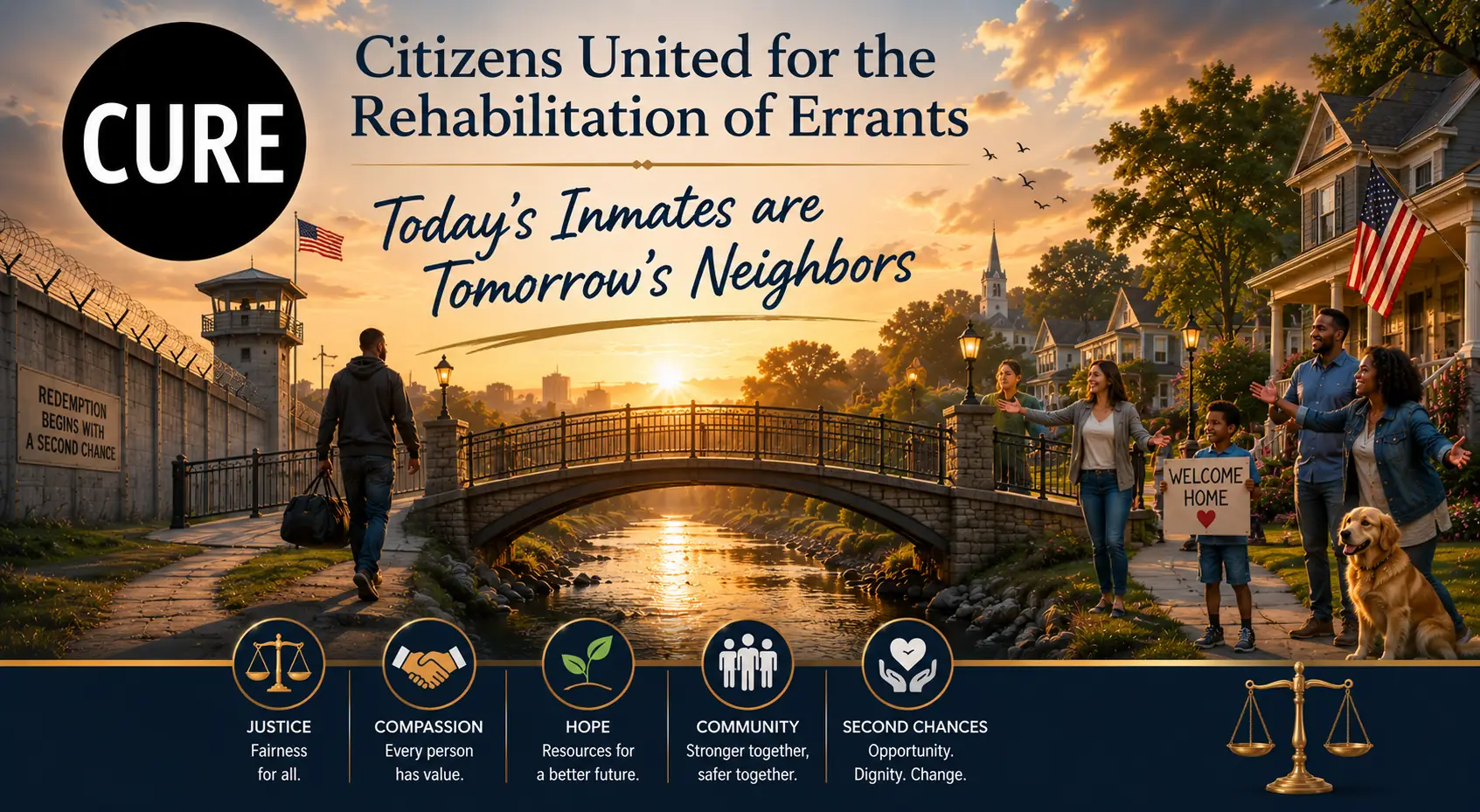
Citizens United for Rehabilitation of Errants (CURE) is a grassroots criminal justice reform organization founded in Texas in 1972 by Charlie Sullivan, a Jesuit priest, and his wife Pauline, a religious sister. Their faith and commitment to social justice, sparked by Charlie's brief experience in a San Antonio jail during a nonviolent civil disobedience action, led them to establish this vital advocacy organization.
Charlie Sullivan's seven days in jail convinced him that systemic reform was essential. He and Pauline believed that prisons should be used only for those who absolutely must be incarcerated, and that people inside deserve all necessary resources to turn their lives around, heal, and be reconciled with their communities. This foundational belief—viewing every person in prison as a child of God with potential to change—remains at the heart of CURE's mission today.
In 1985, CURE incorporated as CURE National with a national office established in Washington, DC to coordinate federal-level advocacy and policy work. Under the same founding vision, International CURE grew into a global network with active chapters in countries including Nigeria, Ghana, Kenya, Senegal, Burundi, Zambia, Malawi, and Rwanda. International CURE holds consultative status with the United Nations to participate in human rights and criminal justice discussions at the global level.
CURE remains a membership-based, secular organization led by formerly incarcerated individuals, family members, and allies. Funded primarily through membership dues and contributions, CURE does not provide direct services. Instead, it equips members with information and advocacy tools to advance a more humane, fair, and effective justice system.
For decades, Charlie and Pauline Sullivan walked the halls of Congress, testifying before committees and organizing grassroots advocates around critical legislation such as:
CURE operates as a federation of state chapters and special-issue chapters that extend the national mission to local and regional levels. Each chapter is volunteer-led and works to advance humane prison conditions, alternatives to incarceration, and fair sentencing within its own state or policy area.
State chapters focus on state-specific reform priorities, such as reducing mandatory minimums, challenging solitary confinement, improving parole systems, and opposing the death penalty. They testify before state legislatures, engage with local media, and organize community education events—all grounded in CURE's founding vision that prisons should be used only where absolutely necessary, and that people inside must have resources to transform their lives.
Special-issue chapters concentrate on particular policy areas that often cut across multiple states, including youth and juvenile justice, sex-offense registry reform, and drug-law reform. These chapters coordinate with CURE National while working directly at the state level, using shared expertise and resources to build targeted, effective campaigns.
When people contact CURE National, they are connected to the appropriate state or special-issue chapter in their area so that local leaders can respond with information, advocacy guidance, and opportunities to get involved. This chapter-based structure allows CURE to remain a grassroots, membership-driven organization, with national coordination and local action working hand in hand.
CURE National's website (curenational.org) is the public hub for U.S.-based advocacy and policy work. The site focuses on federal-level prison reform, death penalty opposition, and coordinates state and issue chapters.
International CURE (internationalcure.org) represents the global network that grew out of the same founding mission. It operates chapters and affiliates across Africa, maintains consultative status with the United Nations, and participates in international human rights and criminal justice advocacy.
Both sites operate under the shared vision of Charlie and Pauline Sullivan: that justice without mercy is not justice at all.